Heirlooms of Tomorrow:
Breeding and Selection for Adaptation to Climate Change
By Seven Seeds Farmer Don Tipping
Heirloom vegetables hold a special place in many people’s hearts. Often they bring us a pleasant nostalgia of our ancestors in different regions preparing scrumptious feasts with garden grown treasures. Technically a vegetable variety can be considered an heirloom once it has been cultivated for over 50 years. Some consider the year 1951 to be a cutoff point for heirlooms because many modern hybrid varieties were introduced at that point. Often a variety achieved heirloom status by virtue of its flavor, appearance and general ability to perform well in a given region. Characteristics such as disease resistance, cold hardiness and vigor were very important before modern crop supports came to dominate the food supply. With respect to vegetable varieties – heirlooms were synonymous with place.
Nowadays, we tend to view heirloom vegetables differently. We want to taste to garden culture of the whole world in our own back yard, despite where we live. Because of the relative youth of our displaced, transplanted culture we conveniently overlook the reality that many of the traits for which heirlooms were selected for had to do with a varietals adaptation to a regions climate, pests, diseases and cultural preferences. Internet shopping, mail-order commerce, FedEx and cell phones have placed the whole world’s wealth within our grasp. Nonetheless, we still can’t dial up our desired climate or day length; there are limits to our technological prowess. Thank goodness!
Take red and purple carrots for instance. In India there exists a cultural preference for these colors in carrots that are predominantly used as cooking carrots. The average climate in India is too warm to produce the crisp, sweet fresh eating carrots that we clamor for at farmers markets across the country. So, what do we do when we desire a rainbow of colors for our bunches of carrots for fresh eating? Well, we turn to the heirloom of another culture and try and use it as we would an orange fresh market variety. Sadly, the results are somewhat lackluster. The flavor of red and purple carrots doesn’t hold a candle to the sugar on a stick sweetness of “Nantes” type carrots to which we have grown accustomed. A plant breeding failure or misguided application for a fine heirloom cooking carrot that grows well in warm subtropical climates? You decide. I’ll stick to my proven regional favorites, thank you.
John Navazio and Matthew Dillon at the Organic Seed Alliance have coined the term, “Heirlooms of Tomorrow” to describe a bioregional-based approach to selection for varieties that perform well within their intended marketplace. While many of our traditional heirlooms are certainly worthy of preserving for their cultural significance and fine attributes, we tend to glorify them based on their heritage alone. I would be happy to put 5 or 6 of our favorite tomatoes up to a flavor test against the current “best- flavor” titleholder, “Brandywine” anytime. They would also have more crack resistance and late blight resistance than that “Brandywine” seed I might otherwise buy from some national seed company. This speaks to the sad fact that many of our available heirlooms are no longer being grown in their region of origin or with attention to selecting them for a diversity of important traits.
Trialing different varieties (or even different strains of the same variety for that matter) are an excellent way to assess the merits of a given variety. While the trial results form a trial performed in the northeast United States many provide some interesting insights, they cannot be relied on as an accurate litmus test for a country as large and climatically varied as the USA.
I was fortunate to recently acquire a large established seed collection from the SOW Organics seed company that operated here in SW Oregon from 1974 until its founder, Al Vanet passed on in 2008. SOW Organics began back in 1974 as Stone Broke Hippie Seeds in Ruch, moving to Williams as Peace Seeds in 1978. This vegetable, flower and herb seed collection represents the best local repository of locally adapted open-pollinated vegetables in SW Oregon if not the entire state. When you consider that seeds of many of the varieties in this collection have been continually reproduced here for over 30 years, starting a garden with this genetic adaptation to climate, pests, soils and diseases in a huge advantage over using seed produced in a different bioregion. Many noteworthy individuals have been involved with this genesis including Gabriel Howearth, Dr. Alan Kapular, Alan Vanet, Alan Adesse, Chi Scherer, Frank Morton, and Munk Bergen to name a few. Sow Organic seeds also helped give rise to another early organic seed pioneer, Seeds of Change.
We have been going through the formidable task of performing germination tests and field trials to asses lot purity and uniformity of the over 200 varieties of vegetables, herbs and flowers. From the information we gather in looking through this germplasm, we hope to build upon the awesome work of Alan Vanet and grow out the true workhorse varieties, selecting to preserve the best qualities of these strains and improving upon them where we see opportunity to do so. I truly believe that this type of work will enable agrarian societies to continue to thrive amidst erratic frost, heat and rain cycles. Domestication is not an endpoint; it is actually an ongoing process of which we are participants.
I believe that plants have the ability to imprint upon the environmental conditions within which they grow. Now consider that many of the seeds available to farmers and gardeners are grown all over the globe. While I do believe that national scale seed companies serve an important role. If we desire to see whole system farm agro-ecosystems thrive, we must have complimentary bioregional seed systems. Ideally, seed would be grown on site as much as possible, when this is not feasible, locally produced seed would be a good alternative.
As regional climate patterns become more erratic, a well-adapted gene pool that has already been bred for adaptation to our local climate affords growers a tremendous advantage. I am curious to test these theories through the trialing of different strains of vegetable varieties in replicated field trials to determine if we are able to see differences between seeds grown in different regions. I am encouraged by stories such as those of Dave Christensen, a farmer and plant breeder in Montana who developed the Painted Mountain Flour corn. Painted Mountain is the result of the intentional crossing of many different ethnic strains of flour corn, with the goal of a producing a short season flour corn that could withstand a variety of stresses. He has a remarkable story of one generation of growing it out wherein the entire crop was flattened by a cataclysmic hailstorm. A few plants managed to survive enough to still yield some seed. Painted Mountain carries this and many other special adaptive traits that benefit growers in this region, enabling them to produce crops more successfully. What is remarkable is that these heavy selection pressures also help when the corn is grown in different climates as well.
With this in mind, should we actually be producing seed under stressful, rather than idealized conditions? A big question, but the more I consider my role as a seedsman I see that we are in a quandary to be economic producing seed while doing selection and breeding that yields the true workhorse varieties. Another story to reinforce this point is that of a neighboring farmer here in SW Oregon named, Jonathan Spero who also works with corn predominately, but in this case the story is that of broccoli. He recognized that broccoli was a crop that was particularly sensitive to stress. Too much heat, cold or weeds will encourage the plant to “button-up” and produced an under-sized, small head prematurely. His hypothesis was that if he could force some plants in a diverse open pollinated population to produce under adverse conditions that their progeny would carry superior genetics into market farmer’s fields. The procedure involved broadcasting the seed thickly and identifying the choice specimens from the broccoli lawn that still managed to grow vigorously and produce a good head of broccoli. Sounds far-fetched you may say, however, the results may convert any skeptics.
There are many such stories from the vanguard of plant breeding that inspire hope and reverence for the elasticity of the plant kingdom. Raoul Robinson shares many compelling examples of horizontal or population breeding in his book, Return to Resistance. Plants want to reproduce themselves, sometimes on-farm conditions can be fairly challenging, we must acknowledge this reality and steward in a new understanding of the intricate relationship between plants, climate and people. The heirlooms of tomorrow? Perhaps. Nature’s road signs are there, the question is, and can we follow them?
Wednesday, July 29, 2009

Thursday, June 25, 2009
Siskiyou Coop Accepts Food Stamps!
Our phone has been ringing off the hook since Monday. The cats are rattled and the kids are annoyed, but I am overjoyed. On Monday, a local TV station came out to Wolf Gulch to do a story on the fact that the Siskiyou Coop CSA will be accepting food stamps in two weeks. They broadcast the story twice that night and again the next morning. Since then, I have spent the greater part of every day on the phone with people interested in signing up.
This all started back in April when my friend Tracy Harding, who manages the Ashland Saturday market and is coordinating an effort to get local produce into school lunches, forwarded me an email about CSAs taking food stamps. It took me about a week to actually look into the prospect, and what I found was daunting. For one thing, the USDA requires a lot of paperwork, and since we are a cooperative, the paperwork was extra challenging. After getting photocopies of all nine Siskiyou Coop farmers drivers licenses and tax id numbers, I found even more difficult coop standards (I honestly can't remember what they were right now), so I tried another tactic. I applied to receive food stamps under Wolf Gulch Farm, instead of the coop, which immediately reduced the paperwork by at least nine-fold.
The next major hurdle came on June 4th, when we got a surprise inspection from a USDA representative. The rep was incredibly nice; he kept commenting on the beauty of the drive out here. Most people who come out here comment on the length and windiness of the drive, so I was especially appreciative of his enthusiasm. I was slightly amused when he walked down into our fields, looked all around and asked "where is the store?" Obviously, we don't fit the standard profile of a food stamp machine applicant. He needed to document our "inventory", so he took some photos of lettuce and carrots growing in the field, some apple trees, and some boxes of softening potatoes and apples from last fall (for home consumption only- I promise!) He seemed very jolly and pleased with his photos. However, when I spoke with the contact woman the next week, she was not pleased and told me there was no way she could license me with no inventory to speak of. I felt dejected, but still slightly amused at our attempt to resemble a "store". In the end, the contact woman worked with me and agreed to license us after I sent her pictures of our first CSA boxes.
The final step is getting the EBT Debit card machine, which will enable us to charge the food stamp recipients. More paperwork and few days wait, but it's on the way, and we'll be ready to use it in a week or so.
All of these headaches are forgotten as I speak to nursing mothers who don't want pesticides in their breastmilk, or elderly people who can't afford quality produce. I have also been deeply touched at the number of our regular CSA members who offered to lend a hand in distributing produce to disabled or elderly people who can't drive. I'll keep you updated on how it all works...
This all started back in April when my friend Tracy Harding, who manages the Ashland Saturday market and is coordinating an effort to get local produce into school lunches, forwarded me an email about CSAs taking food stamps. It took me about a week to actually look into the prospect, and what I found was daunting. For one thing, the USDA requires a lot of paperwork, and since we are a cooperative, the paperwork was extra challenging. After getting photocopies of all nine Siskiyou Coop farmers drivers licenses and tax id numbers, I found even more difficult coop standards (I honestly can't remember what they were right now), so I tried another tactic. I applied to receive food stamps under Wolf Gulch Farm, instead of the coop, which immediately reduced the paperwork by at least nine-fold.
The next major hurdle came on June 4th, when we got a surprise inspection from a USDA representative. The rep was incredibly nice; he kept commenting on the beauty of the drive out here. Most people who come out here comment on the length and windiness of the drive, so I was especially appreciative of his enthusiasm. I was slightly amused when he walked down into our fields, looked all around and asked "where is the store?" Obviously, we don't fit the standard profile of a food stamp machine applicant. He needed to document our "inventory", so he took some photos of lettuce and carrots growing in the field, some apple trees, and some boxes of softening potatoes and apples from last fall (for home consumption only- I promise!) He seemed very jolly and pleased with his photos. However, when I spoke with the contact woman the next week, she was not pleased and told me there was no way she could license me with no inventory to speak of. I felt dejected, but still slightly amused at our attempt to resemble a "store". In the end, the contact woman worked with me and agreed to license us after I sent her pictures of our first CSA boxes.
The final step is getting the EBT Debit card machine, which will enable us to charge the food stamp recipients. More paperwork and few days wait, but it's on the way, and we'll be ready to use it in a week or so.
All of these headaches are forgotten as I speak to nursing mothers who don't want pesticides in their breastmilk, or elderly people who can't afford quality produce. I have also been deeply touched at the number of our regular CSA members who offered to lend a hand in distributing produce to disabled or elderly people who can't drive. I'll keep you updated on how it all works...
Wednesday, June 17, 2009
Quality Control in the Coop
Growing high quality, organic produce has become easier as people have gained a greater understanding of how to manage pests and disease, and farmers have adopted good harvest and post-harvest handling practices. Without the quick fix of most herbicides and insecticides, organic farmers must rely on a whole range of pest management practices. These include mechanical control of weeds, crop rotation, biological controls (introducing one organism to control another organism), covering plants at risk of insect predation, keeping plants healthy with appropriate fertilization and irrigation, and much more. Farmers now know the best times of day to harvest each crop, and the optimal temperatures and humidity levels at which to store harvested produce. Even with all this valuable information, organic farmers are constantly challenged by both new and familiar insects, and plant disease. Often, farmers will have to till in or compost crops that have too much insect damage to salvage for market. This can be one of the most difficult aspects of farming. Fortunately, most small, organic farmers are highly diversified- growing up to 50 different crops, so some crop loss is expected and can be tolerated by the whole operation.
In the midst of these challenges, farmers have to consider what their quality standards are. How many holes can a leaf of chard have? How uniform do your bunches of radishes need to be? Retail and wholesale buyers and chefs have very high standards for quality. Customers who buy at growers markets also tend to pick out the best-looking produce in a booth.
Quality control has been the single greatest challenge of running a cooperative CSA. We all want the boxes to look good and our members to be satisfied, but there have been different ideas of what quality looks like. A year and a half ago, the coop farmers set out to create quality standards. We sat down with a list of the fruits and vegetables we offer and came up with specifications for what was acceptable to put in the CSA boxes. Some farmers wanted the standards to be more lenient- suggesting that people who join a CSA are accepting part of the risk in the farms, and should understand a certain amount of crop degradation. In the end, we agreed to adopt very high quality standards, based on the rationale that CSA members are paying for high quality produce and are entrusting us to put the best produce in their boxes.
We continue to try to deliver high quality produce to our members every week, but our system is not perfect.
Please let us know if any item you receive seems at all questionable. We rely on your feedback to make our CSA topnotch. We will also gladly replace any item in your box the following week.
Now, back to those carrots...
In the midst of these challenges, farmers have to consider what their quality standards are. How many holes can a leaf of chard have? How uniform do your bunches of radishes need to be? Retail and wholesale buyers and chefs have very high standards for quality. Customers who buy at growers markets also tend to pick out the best-looking produce in a booth.
Quality control has been the single greatest challenge of running a cooperative CSA. We all want the boxes to look good and our members to be satisfied, but there have been different ideas of what quality looks like. A year and a half ago, the coop farmers set out to create quality standards. We sat down with a list of the fruits and vegetables we offer and came up with specifications for what was acceptable to put in the CSA boxes. Some farmers wanted the standards to be more lenient- suggesting that people who join a CSA are accepting part of the risk in the farms, and should understand a certain amount of crop degradation. In the end, we agreed to adopt very high quality standards, based on the rationale that CSA members are paying for high quality produce and are entrusting us to put the best produce in their boxes.
We continue to try to deliver high quality produce to our members every week, but our system is not perfect.
Please let us know if any item you receive seems at all questionable. We rely on your feedback to make our CSA topnotch. We will also gladly replace any item in your box the following week.
Now, back to those carrots...
Thursday, June 11, 2009
First Delivery Day!
Tom and I are up early, checking and rechecking our lists for the first delivery day, and looking out on some thick Applegate fog.
This time of year always comes with a certain amount of stress, as there are a lot of details to keep track of in a cooperative CSA with multiple extra items in addition to dozens of field crops. But there is also something deeply satisfying about distributing our produce and other locally grown products all around the Rogue Valley- into a hundred different households.
The growing season so far this spring has been pretty good. As you probably noticed, the weather was all over the place- with perfect 70 degree days; cold, wet spells; thunderstorms with pelting rain; and a week of 90 degrees. At Wolf Gulch, we struggled to keep up with the weeds last week, as the beds were too wet to hoe in, but the growing conditions were ideal. Some stands of pigweed began to dwarf our lettuce crop and crowd around the young onions and leeks. On Monday when the fields were dry enough to cultivate in, our friends at Boones Farm sent over a crew of five to tackle the weeds. We made a lot progress and are back on track. Well, as much to be expected this time of year.
Josh and Melissa at Barking Moon Farm in the Applegate had a dramatic weather episode last week: On Tuesday, their little valley up Thompson Creek Road was hit by a hail storm. They lost about 40% of their crops- mostly salad greens and spinach. Melissa described the fields as looking like a blender had run through them. Luckily, the greens are growing quickly this time of year, so they expect to be back in full production in a couple of weeks. Still, they lost a lot- in revenue, time and heartache, and it's a good reminder to all of us of the inherent risks in farming. If you attend the growers markets, go visit Josh and Melissa, buy some of their stuff, and thank them for farming.
Members new and old: please stay in touch with us through the season. We depend on feedback and will do our best to meet your needs. If you are overwhelmed by the number of greens in your box this week, try out some of the recipes. When in doubt, saute the bunch of kale or bag of spinach, and you'll probably be amazed at how much the volume reduces.
Thanks of being part of our Community Supported Agriculture Program
This time of year always comes with a certain amount of stress, as there are a lot of details to keep track of in a cooperative CSA with multiple extra items in addition to dozens of field crops. But there is also something deeply satisfying about distributing our produce and other locally grown products all around the Rogue Valley- into a hundred different households.
The growing season so far this spring has been pretty good. As you probably noticed, the weather was all over the place- with perfect 70 degree days; cold, wet spells; thunderstorms with pelting rain; and a week of 90 degrees. At Wolf Gulch, we struggled to keep up with the weeds last week, as the beds were too wet to hoe in, but the growing conditions were ideal. Some stands of pigweed began to dwarf our lettuce crop and crowd around the young onions and leeks. On Monday when the fields were dry enough to cultivate in, our friends at Boones Farm sent over a crew of five to tackle the weeds. We made a lot progress and are back on track. Well, as much to be expected this time of year.
Josh and Melissa at Barking Moon Farm in the Applegate had a dramatic weather episode last week: On Tuesday, their little valley up Thompson Creek Road was hit by a hail storm. They lost about 40% of their crops- mostly salad greens and spinach. Melissa described the fields as looking like a blender had run through them. Luckily, the greens are growing quickly this time of year, so they expect to be back in full production in a couple of weeks. Still, they lost a lot- in revenue, time and heartache, and it's a good reminder to all of us of the inherent risks in farming. If you attend the growers markets, go visit Josh and Melissa, buy some of their stuff, and thank them for farming.
Members new and old: please stay in touch with us through the season. We depend on feedback and will do our best to meet your needs. If you are overwhelmed by the number of greens in your box this week, try out some of the recipes. When in doubt, saute the bunch of kale or bag of spinach, and you'll probably be amazed at how much the volume reduces.
Thanks of being part of our Community Supported Agriculture Program
Wednesday, June 3, 2009
Now offering: Locally roasted Cold Pressed Coffee!
This blog post was written by Asher Yaron, who is currently offering locally roasted coffee through our CSA program.
Cold Pressed Coffee - A Healthy Elixir!
Recently I was introduced to a process of making coffee called, cold pressed. I was so im-pressed by the
delicious flavor and smoothness that I have made it a significant part of my business. Cold pressed
coffee stays fresh for weeks in the refrigerator and you can't beat the convenience. Just take it out of the fridge
and either heat it up or add ice. No equipment necessary!
I am now making and delivering cold pressed coffee in 1 qt. containers for $10 each. Cold pressed coffee is a concentrate and is usually diluted with water (1 part cold pressed to 3-5 parts water). It is ideal for entertaining and perfect for iced blended coffee drinks on a hot summer day.
Like many other cold pressed food processes it is a healthier option. Cold pressed coffee contains 60% less acid and 50% less caffeine. It is very smooth with no bitter aftertaste. If you are a coffee lover and have never tried it, I highly recommend it!
Here is how I create this delicious elixir:
1. The first step is to obtain freshly roasted coffee beans (I know where you can get some!).
2. I grind the beans on a coarse setting (I use 5 lbs. of beans for each batch and 3 gallons of water).
3. I then place the coarsely ground coffee in a large container that has a super-sized coffee filter.
4. Fresh well water is then sprinkled on the grounds (use 1/2 - 3/4 of a gallon of water for each pound of coffee).
5. Allow the water and grounds to soak for 24 hours.
6. Drain the liquid and keep stored in the refrigerator.
Give it a try.....and remember, fresh roasted always tastes better!
Cold Pressed Coffee - A Healthy Elixir!
Recently I was introduced to a process of making coffee called, cold pressed. I was so im-pressed by the
delicious flavor and smoothness that I have made it a significant part of my business. Cold pressed
coffee stays fresh for weeks in the refrigerator and you can't beat the convenience. Just take it out of the fridge
and either heat it up or add ice. No equipment necessary!
I am now making and delivering cold pressed coffee in 1 qt. containers for $10 each. Cold pressed coffee is a concentrate and is usually diluted with water (1 part cold pressed to 3-5 parts water). It is ideal for entertaining and perfect for iced blended coffee drinks on a hot summer day.
Like many other cold pressed food processes it is a healthier option. Cold pressed coffee contains 60% less acid and 50% less caffeine. It is very smooth with no bitter aftertaste. If you are a coffee lover and have never tried it, I highly recommend it!
Here is how I create this delicious elixir:
1. The first step is to obtain freshly roasted coffee beans (I know where you can get some!).
2. I grind the beans on a coarse setting (I use 5 lbs. of beans for each batch and 3 gallons of water).
3. I then place the coarsely ground coffee in a large container that has a super-sized coffee filter.
4. Fresh well water is then sprinkled on the grounds (use 1/2 - 3/4 of a gallon of water for each pound of coffee).
5. Allow the water and grounds to soak for 24 hours.
6. Drain the liquid and keep stored in the refrigerator.
Give it a try.....and remember, fresh roasted always tastes better!
Monday, October 6, 2008
Somehow I figured that the longer I did something, the more proficient I would become at doing it. Experience begets mastery. Right? Well, maybe at the piano, or ping pong, but not farming. It almost seems as if the longer I do this absurd, yet critical vocation/lifestyle, the more ways I realize that I can get hornswaggled by mother nature. Take our cucumber crop this year for instance. Last year we trialed a new variety of Middle Eastern cucumber (also known as the biet alpha group of cucumber varieties) called Diva from Seeds of Change seeds. Trialing is the process of growing a small amount of different varieties side by side in order to evaluate them more thoroughly under your own field’s growing conditions. We were impressed with its smooth skin free from bitter taste and sweet crunchy flesh. So this year we figurd that we would try growing a couple rows of it to share with the CSA members, excited to share what we thought was a superior variety.
Fast forward to June 2008. Summer weather didn’t grace our piece of paradise on the north slope of Sugarloaf mountain (elev. 6870 feet) here in Williams until after the summer solstice. The slow start of warm weather this summer proved to challenge the early season vigor of all the hot weather crops. Not to be tricked by late starts of the Siskiyous, we had covered our cuc’s with remay (spun polyester fabric, kinda like quilt facing) at planting time to insulate them against cold nights and more importantly protect them from the arch nemesis of all cucerbitacea family plants – the dreaded cucumber beetle. So our cucumbers happily grew (slowly I might add) under the remay until warmer temperatures coaxed into liberating them to feel the suns rays directly. We were assured that they had grown enough foliage to combat and pestilence.
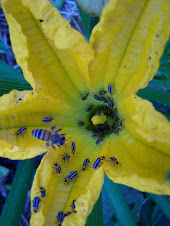
The sharp claws of reality sink deep into vegetable flesh. As the fruits began to develop and we walked the rows to asses when to begin picking we noticed that not only did we have a preference for the fruits of the middle eaten cucumber but so did both the spotted and striped cucumber beetles. Not only did they like it, they relished it with a parasitic fervor. The small fruits were crisscrossed with the feeding tracks of the beetles so much so as to resemble the way an engraver beetle chews on a pine log. We were growing another couple rows of tradition Market more green cucumbers and pale yellow lemon cucumbers next to out choice specialty ones and they were largely spared the plague. , Not to be outdone. We figured that the damage was simply an early season fluke, so we took drastic measures and harvested the entire first flush (about 200 pounds) of cucumbers and fed them to out ducks and chickens. Confident that it would enable the plants to redirect their energy into growing new fruits with less damage. But noooo…., Striiike two!, Once again the fruits we horribly scarred and eaten with wounds oozing gelatinous cucumber sap. We counted our losses and tried to get some yield from the patch and sorted out the worst of the worst and wound up feeding another couple wheelbarrow loads of cucs to our enthusiastic ducks, chickens and turkeys. This continued for a few weeks until we were unable to meet our CSA’s quality standards and now the crop sits unharvested, a writhing cesspool of cucumber beetles munching in an orgy of pestilence. To add injury to defeat, their feeding transmits both cucumber mosaic virus and powdery mildew fungus to the leaves of the plants, so the neighboring ones don’t look too good either. A silver lining to this tragedy is that our interns and we made some mean pickles and tasty relish from some of the culls that we will savor in the winter months to come., As a farmer I want to be able to relay this story to those who marvel at beautiful fruits and vegetables in a CSA box or the market stand, completely innocent of the carnage that lies in waste in the dark recesses of the down and dirty world of domestication and cultivation. For every perfect fruit in a CSA box there is often one or two ugly ones sitting in the row in the field, harvested and rejected. If the rejects are lucky, they get rounded up and fed to livestock on the farm, but all too often they aren’t worth the effort and they get tilled back into the soil to nourish the soil and conjure luck in the quest for cosmetically beautiful food. In a perfect world consumers would be as concerned about the beauty within the fruit (the care put into growing soil and preserving biodiversity on the land) as the physical beauty on the outside of the fruit. Besides, perhaps the bugs are actually showing us which fruits are the most nutritious of the lot. Hmmmm…, Don Tipping, Waning in the wee hours at Seven Seeds Farm on Sugarloaf Mountain 2008
Fast forward to June 2008. Summer weather didn’t grace our piece of paradise on the north slope of Sugarloaf mountain (elev. 6870 feet) here in Williams until after the summer solstice. The slow start of warm weather this summer proved to challenge the early season vigor of all the hot weather crops. Not to be tricked by late starts of the Siskiyous, we had covered our cuc’s with remay (spun polyester fabric, kinda like quilt facing) at planting time to insulate them against cold nights and more importantly protect them from the arch nemesis of all cucerbitacea family plants – the dreaded cucumber beetle. So our cucumbers happily grew (slowly I might add) under the remay until warmer temperatures coaxed into liberating them to feel the suns rays directly. We were assured that they had grown enough foliage to combat and pestilence.
The sharp claws of reality sink deep into vegetable flesh. As the fruits began to develop and we walked the rows to asses when to begin picking we noticed that not only did we have a preference for the fruits of the middle eaten cucumber but so did both the spotted and striped cucumber beetles. Not only did they like it, they relished it with a parasitic fervor. The small fruits were crisscrossed with the feeding tracks of the beetles so much so as to resemble the way an engraver beetle chews on a pine log. We were growing another couple rows of tradition Market more green cucumbers and pale yellow lemon cucumbers next to out choice specialty ones and they were largely spared the plague. , Not to be outdone. We figured that the damage was simply an early season fluke, so we took drastic measures and harvested the entire first flush (about 200 pounds) of cucumbers and fed them to out ducks and chickens. Confident that it would enable the plants to redirect their energy into growing new fruits with less damage. But noooo…., Striiike two!, Once again the fruits we horribly scarred and eaten with wounds oozing gelatinous cucumber sap. We counted our losses and tried to get some yield from the patch and sorted out the worst of the worst and wound up feeding another couple wheelbarrow loads of cucs to our enthusiastic ducks, chickens and turkeys. This continued for a few weeks until we were unable to meet our CSA’s quality standards and now the crop sits unharvested, a writhing cesspool of cucumber beetles munching in an orgy of pestilence. To add injury to defeat, their feeding transmits both cucumber mosaic virus and powdery mildew fungus to the leaves of the plants, so the neighboring ones don’t look too good either. A silver lining to this tragedy is that our interns and we made some mean pickles and tasty relish from some of the culls that we will savor in the winter months to come., As a farmer I want to be able to relay this story to those who marvel at beautiful fruits and vegetables in a CSA box or the market stand, completely innocent of the carnage that lies in waste in the dark recesses of the down and dirty world of domestication and cultivation. For every perfect fruit in a CSA box there is often one or two ugly ones sitting in the row in the field, harvested and rejected. If the rejects are lucky, they get rounded up and fed to livestock on the farm, but all too often they aren’t worth the effort and they get tilled back into the soil to nourish the soil and conjure luck in the quest for cosmetically beautiful food. In a perfect world consumers would be as concerned about the beauty within the fruit (the care put into growing soil and preserving biodiversity on the land) as the physical beauty on the outside of the fruit. Besides, perhaps the bugs are actually showing us which fruits are the most nutritious of the lot. Hmmmm…, Don Tipping, Waning in the wee hours at Seven Seeds Farm on Sugarloaf Mountain 2008
Saturday, July 19, 2008
Recent CSA Questions Answered
Hi,
I've gotten three interesting questions from CSA members this week that I thought I would answer on here for the benefit of all:
Q. Why is my lettuce spotted? Is it supposed to be that way?
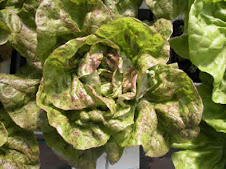
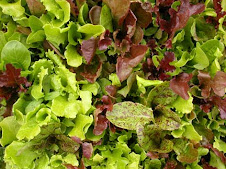
A. The lettuce that some of you received this week is a variety called "speckles" which originated in Holland in the 17th century. I guess the Dutch found the speckled look attractive, so they saved the seed. The variety found it's way first to Germany where it was very popular, and then on to North America in the 1790s. The original name "forellenschluss" comes from the German for "speckled like a trout."
Q. Why does my bag of berries smell like tobacco smoke?
A. This is actually the second time I've heard the same question. The first time I heard the question, I was obviously disturbed, and racked my brain as to how tobacco smoke could have interfaced with our produce. We always pack the berries in bags on Thursday mornings, and I have certainly never seen anyone smoke at the CSA packout- it is unthinkable. A week later, I was pulling bags off the roll, and smelled something odd- not exactly like tobacco smoke, but something less-than-pleasant. I suddenly realized that the bags themselves smell.
We started buying bags this year from a company called Trellis Earth. The bags are made from corn starch and are therefore bio-degradable, but indeed, they don't smell very good, especially when they have been in plastic CSA box for most of the day. The two people who asked about the smell said that their produce wasn't affected, and that only the outside of the bags smell. We would like to continue using bio-degradable bags, but certainly don't want to offend members. Please add your comments to this.
Q. Can you give me some food preservation suggestions?
A. Rather than answer that, I'll direct you to a few of good websites. Aside from canning, you can also blanche and freeze or dry excess produce. Check out these sites for more info:
http://www.extension.umn.edu/distribution/nutrition/DJ0555.html
http://www.cooksillustrated.com/images/document/howto/JA07_IlloSpread-FreezingProduce.pdf
http://www.recipes4us.co.uk/Cooking/Drying%20Food.htm
Thanks for the questions- please keep them coming...
I've gotten three interesting questions from CSA members this week that I thought I would answer on here for the benefit of all:
Q. Why is my lettuce spotted? Is it supposed to be that way?
A. The lettuce that some of you received this week is a variety called "speckles" which originated in Holland in the 17th century. I guess the Dutch found the speckled look attractive, so they saved the seed. The variety found it's way first to Germany where it was very popular, and then on to North America in the 1790s. The original name "forellenschluss" comes from the German for "speckled like a trout."
Q. Why does my bag of berries smell like tobacco smoke?
A. This is actually the second time I've heard the same question. The first time I heard the question, I was obviously disturbed, and racked my brain as to how tobacco smoke could have interfaced with our produce. We always pack the berries in bags on Thursday mornings, and I have certainly never seen anyone smoke at the CSA packout- it is unthinkable. A week later, I was pulling bags off the roll, and smelled something odd- not exactly like tobacco smoke, but something less-than-pleasant. I suddenly realized that the bags themselves smell.
We started buying bags this year from a company called Trellis Earth. The bags are made from corn starch and are therefore bio-degradable, but indeed, they don't smell very good, especially when they have been in plastic CSA box for most of the day. The two people who asked about the smell said that their produce wasn't affected, and that only the outside of the bags smell. We would like to continue using bio-degradable bags, but certainly don't want to offend members. Please add your comments to this.
Q. Can you give me some food preservation suggestions?
A. Rather than answer that, I'll direct you to a few of good websites. Aside from canning, you can also blanche and freeze or dry excess produce. Check out these sites for more info:
http://www.extension.umn.edu/distribution/nutrition/DJ0555.html
http://www.cooksillustrated.com/images/document/howto/JA07_IlloSpread-FreezingProduce.pdf
http://www.recipes4us.co.uk/Cooking/Drying%20Food.htm
Thanks for the questions- please keep them coming...
Subscribe to:
Posts (Atom)